
Many probably think that these two words cannot be associated. Dubai is built in the desert, it is made of high glass towers where the greenhouse effect is experienced every single moment, and cars are kings and queens of its streets! Well… all this is true, but many other facts tend to mitigate these statements, from recycling tests to the car-free day, Dubai is trying to make its existence sustainable beyond the cheap energy era that we are living in. One of these initiatives is taken by Diamond Developers, and it is simply called the Sustainable City.
We, at eedama, went for a visit to see with our own eyes what a sustainable city could look like in the desert. At first, it looks normal: A residential complex being built in Dubailand, east of Dubai downtown. As we have been wandering around Masdar City lately (for those of you who don’t know it: we’ll write about it soon!) we had an element of comparison in mind… But we had to acknowledge: the two projects are completely different. While Masdar City is a real-size sustainability and energy-saving experiment where all inhabitants have a link with sustainability (and where the AC temperature is set at 23C minimum) the Sustainable City is a commercial project with actual villas bought by actual customers. But a sustainable way of life is not any way of life… And that makes it interesting: is it possible to actually sell a house that comes with a way of life?
So let us first describe what makes The Sustainable City … sustainable: the general philosophy is to gather a social, technical and economical ecosystem.
- Social means that everything is made to favour human beings and human interactions instead of machines or separation walls. The intention is therefore to take cars as far as possible from the heart of the residential areas. Pedestrians are at home in the streets, with shaded places and benches, as well as community locations (a garden, a small mall, sports areas) all accessible by foot.
- Technical means that there are a number of features that allow the city to consume much less energy than other villa complexes in the region: old Arab and Persian techniques were modernised and reused, such as the Barjeel (or Bagdir, wind-tower that brings in fresh air from higher altitudes) and the (relatively) narrow streets. As many areas as possible are shaded. And of course solar panels for water heating and electricity are everywhere…
- Economical means that there will be some activity onsite (an edutainment center, an innovation center). However these will be the last to arrive onsite. For the moment, approximately one quarter of the houses are occupied, but none of the special features are finished yet.
After the description… Some thoughts!
We liked the idea of having a commercially sustainable city. That makes it accessible to people who do not necessarily have a link to the topic. Sustainability is not only recycling and solar energy, sustainability is accepting that the infinite accumulation of goods and the permanent growth of our consumption are not possible on a finite planet. This will require a paradigm shift, where happiness is not measured by quantitative means (money, cars) but by qualitative means (health, social links). The sustainable city takes this into account: The effort to include a friendly atmosphere in the city, triggering human encounters, is real and visible.
On another note, there is a real effort to perform as many activities as possible onsite, thereby reducing transport costs and pollution. We were impressed by the “sort of greenhouse” that actually cools down the inside instead of heating up… using energetically efficient techniques: an adaptation of the barjeel.
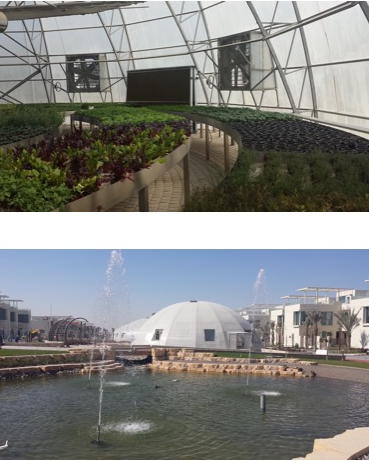
Picture of the evaporative cooling based greenhouses
On the down-side: We are still wondering if providing an electric mini-car with every house is really serving the purpose … it’s as if The Sustainable City developers were willing to propose a paradigm shift in the way of life (hey people: walk and meet your neighbours instead of driving and meeting your screen (GPS, GSM…)) but at the same time they are afraid that it might frighten some potential customers used to the lazy comfort of the UAE lifestyle.
To finish on a super-nice aspect: We liked the solar photovoltaic and thermal panels everywhere and used in multiple ways. Every house has its own solar water heating, as well as solar photovoltaic panels to produce electricity. Photovoltaic panels are also used as the shade parking, as well as on roofs, a bit like mashrabiya. The total production should reach 10Mwp (megawatt peak) [Footnote:that means it will be able to supply electricity to 10 000 microwave ovens or AC units when the sun is shining “normally”]. The city is connected to the national distribution grid, as DEWA recently allowed, in a very positive step, very innovative for an oil-producing country. The Sustainable City is not aiming at being isolationist, and we support that in eedama: the future is to smart grids, not for isolated independent cities. [Footnote: Smart grids are made of several different electricity sources that will allow a permanent feeding of the grid, and demand-monitoring in order to match it with the supply.]
One more time: way to go!
Ounsi - From Eedama - March 2016